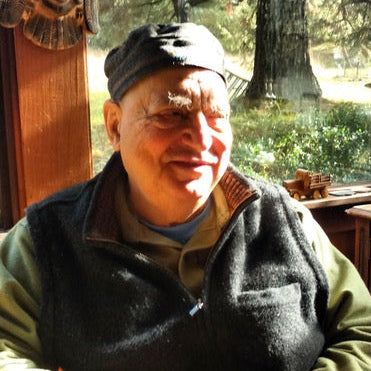
Where Do Songs Come From? A Lecture Series with Allaudin (W. A. Mathieu)
Where Do Songs Come From? A Lecture Series with Allaudin (W. A. Mathieu)
Couldn't load pickup availability
- Lectures
- Sundays (November 8, 15, 22 & 29)
- Time
- 1 PM PT
- Plus
- Wednesday Q&As (November 11, 18 & 25)
- Format
- Live on Zoom · recordings sent out afterwards
We’re honored to welcome Allaudin (W. A. Mathieu) to School of Song for a four-week lecture series beginning November 8. You’ll walk away from this class not just with new songs, but new understandings of what it means to write a song.
A few words about the course from Allaudin
November 8: Melody
“Where Do Songs Come From?” might be a fine title, but it’s a trick question since there isn’t a clear answer except, perhaps, everywhere. But the question does pique our curiosity. For instance, were the first songs conversations with animals? Exaggerations of speech? When did sustained tones—very rare in nature—occur in the evolution of our ear? When did melodies become tonal and what does tonal mean? How do we recognize melodic patterns? How can wordless melodies tell stories?
November 15: Harmony
More questions: Can the ear actually track two tones at once? Three tones? Eight? By what magic do tones turn into chords, chords into progressions, and chord progressions into stories—personal stories? This is a deep, mysterious, and very long game which we will approach with the help of a harmonic lattice, a useful graphic that is almost a picture of the way the ear hears tonal harmony.
November 22: Words
How can words, which so often are guileful abstractions, touch our hearts so deeply? What distinguishes poetry from lyrics? We will look at metaphor, etymology, rhythmic language, the cadences of speech vs. the cadences of music, and the myriad weddings of words to music.
November 29: Songs
More questions we might ask: What is the intention—or the mix of intentions—behind writing a song in the first place? What does it mean for a song to come through you? As you are composing, who else is listening? We’ll look at euphony, melisma, modes and modality, related keys in respect to related ideas, interior and exterior references, intimate vs. universal, and whatever else under heaven falls by.
From Allaudin
This outline is a guide only. There are guaranteed to be irresponsible meanderings, jokes whenever, stories of the famous and infamous, and brief interludes of me playing piano because I go crazy when I talk too long. I’m looking forward to being with you all.
About Allaudin
Allaudin (W. A. Mathieu) is a composer, pianist, teacher, and author of Harmonic Experience, The Listening Book, The Musical Life, Bridge of Waves, and The Shrine Thief. He composed and arranged for the Duke Ellington and Stan Kenton orchestras, studied with North Indian vocalist Pandit Pran Nath for 25 years, and taught at Mills College and the San Francisco Conservatory of Music. His work spans solo piano recordings, chamber music, choral works, and song cycles.
For a sense of his voice and music together, listen to “Originality” from The Listening Book and The Musical Life, or explore the full audio collection.
Course Logistics
Lectures: Sundays November 8, 15, 22, and 29, 2026 at 1 PM Pacific (4 PM Eastern).
Q&As: Wednesdays November 11, 18, and 25, 2026 at 1 PM Pacific (4 PM Eastern).
Format: Four live lectures and three Q&A sessions over Zoom. Each session is expected to run 60–90 minutes.
Tuition: $200 for the series.
FAQ
Who is this class for?
Songwriters, instrumentalists, singers, composers, and curious listeners who want to deepen their understanding of music. You might be looking for language for things you already hear, new possibilities for your writing, or a fresh perspective on familiar musical ideas. The series welcomes different experience levels.
What musical experience should I have?
The lectures will assume you recognize the note names A – G and have a basic idea of what a scale is. Familiarity with intervals, such as an octave, fifth, or third, and with chords and a tonic or “home” note will help you follow the discussions of melody and harmony. You don’t need advanced theory knowledge.
I’m newer to music theory. Can I still participate?
Yes. Much of the class can be approached through listening, musical examples, and Allaudin’s reflections on making music. Some technical passages will take more time to understand, and the lectures won’t teach every concept from the beginning. If note names and scales are entirely new to you, expect to do some additional learning alongside the class. You don’t need to understand everything on first hearing to get something meaningful from it.
How will School of Song support different levels?
Our teaching team will be present during the lectures to support the discussion and gather questions. We’ll provide supplementary resources to clarify unfamiliar terms and help you return to the ideas introduced in class. Newer students can use these to connect the vocabulary to what they hear; experienced students can follow the more detailed ideas and bring specific questions. Both kinds of curiosity are welcome.
I’ve already studied music extensively. Is this class for me?
Absolutely! Allaudin’s approach invites you to reconsider familiar ideas through the way they sound and feel: how a home note is established, how harmonic relationships create movement, and how musical choices carry meaning. The series will range from fundamental questions to detailed explorations, with room to encounter something unfamiliar at any level.
I can’t make the live sessions. Can I still participate?
Yes! All lectures and Q&A sessions will be recorded and made available to enrolled students. We send out lecture recordings at the end of each class day, so you can watch on your own time.
Is there a minimum age?
Yes, our live classes are open to anyone 18 and older.
Can I give the class as a gift?
Yes! Add the class to your cart with “This is a gift” checked and enter the recipient’s information. If you’re also enrolling yourself, add a second registration normally.
What is the refund policy?
If after the first class you feel the course is not a good fit for any reason, you are welcome to a refund on the rest of the course classes. We are unable to process refunds after the second class. No refunds on discounted orders.
Financial Aid
We want as many people as possible to experience Allaudin’s teaching. If cost is a barrier, email us at hi@schoolofsong.org and we’ll work with you to make it possible.
Questions? Email us at hi@schoolofsong.org.
Share